Image Annotation at Scale

Building the Pipeline for Patient-Generated Dental Data
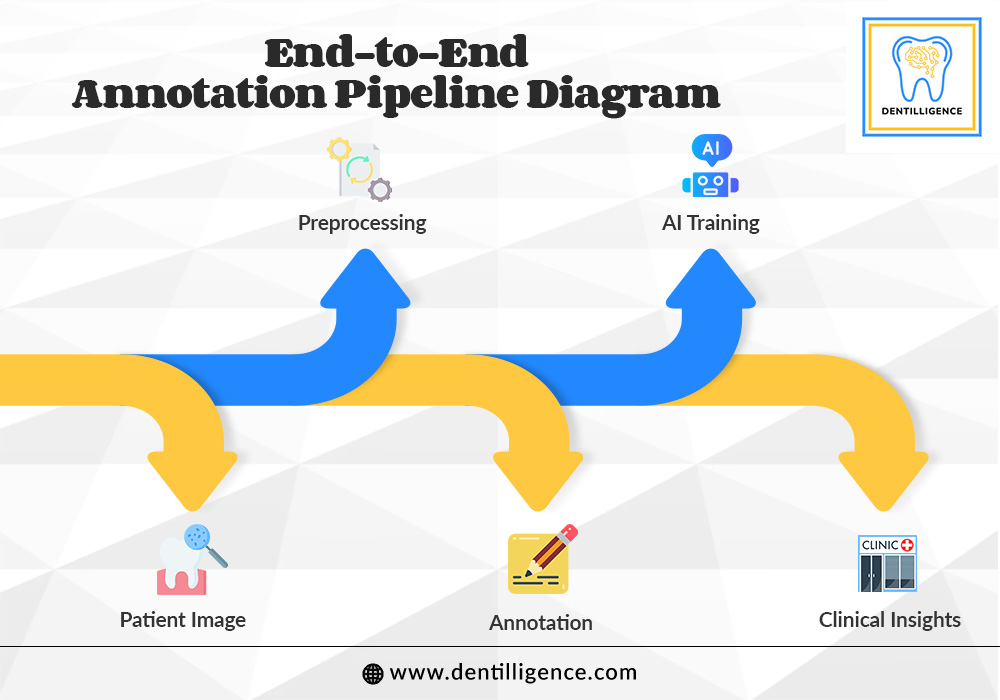
As digital dentistry evolves, patient-generated images—captured via smartphones, intraoral cameras, and monitoring apps—are becoming vital for AI diagnostics and teledentistry. However, transforming these images into high-quality training data requires a rigorous, scalable annotation pipeline.

The Challenge of “Noisy” Data Unlike controlled clinical X-rays, patient photos suffer from inconsistent lighting, varying angles, partial obstructions, and distracting backgrounds. To make this data usable for AI, standardization is the first major hurdle.

Key Stages of the Pipeline

  1. Ingestion and Preprocessing The process begins with secure data ingestion. Systems must automatically normalize metadata, remove duplicates, and perform strict pseudonymization to comply with HIPAA and GDPR. Once ingested, preprocessing tools standardize the visual input. Critical steps include:

Auto-cropping to the specific mouth region.

Color and lighting normalization to reduce environmental variables.

Orientation correction to align the dental arch.

  1. Protocols and Workforce Accurate labeling requires clear protocols for tooth numbering and pathology identification. Executing this at scale demands a tiered workforce:

General Annotators: Handle basic segmentation (e.g., separating teeth from gums).

Dental Professionals: Validate complex cases, identify specific pathologies (cavities, inflammation), and oversee Quality Control (QC).

QC Mechanisms: Consensus labeling and “gold standard” benchmarks ensure the data is reliable enough for clinical AI training.

AI Assistance and Security
AI accelerates the workflow using “human-in-the-loop” systems. Algorithms pre-annotate clear images and flag ambiguous cases for expert review, increasing speed without sacrificing accuracy. Throughout this process, data security is non-negotiable; encryption, access logs, and de-identification must protect Patient Health Information (PHI) at every stage.

Conclusion
A scalable annotation pipeline—combining AI efficiency, human expertise, and strict security—is the foundation of modern dental AI. It turns raw, messy patient photos into actionable clinical insights, enabling proactive and personalized care.

Tags

Share

    Other posts